Are you planning to turn agricultural residues or sawmill waste into high-profit fuel sticks? The profitability of a biomass briquette plant depends heavily on your choice and preparation of raw materials.
Many new investors assume that any loose biomass can simply be poured into an extruder hopper to yield dense, glossy charcoal briquettes. In industrial production, however, over 70% of briquetting failures—such as bar cracking, mold clogging, excessive smoking, and low density—stem from improper raw material preparation.
In this guide, Shuliy Machinery breaks down the science behind raw materials for charcoal briquettes, covering the critical roles of natural lignin, strict moisture and sizing thresholds, and performance metrics across 8 popular biomass types.
The Science of Binderless Briquetting: The Role of Lignin
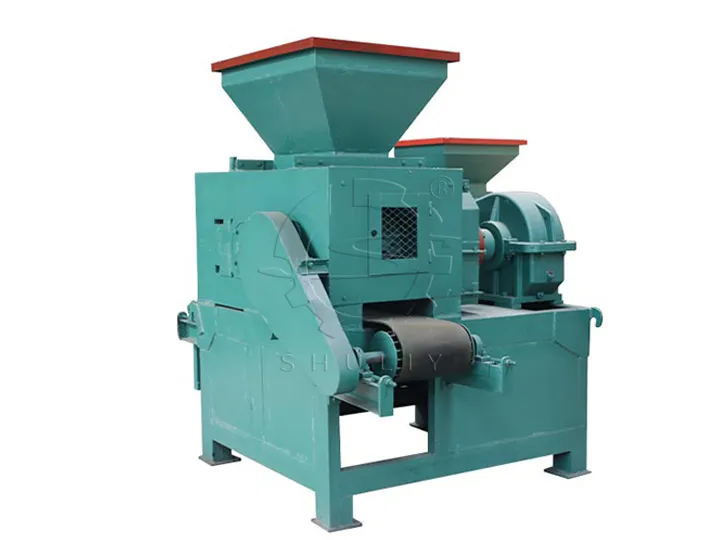
Unlike cold hydraulic or roller pressing, an industrial screw-type charcoal briquette machine operates without adding chemical binders or adhesives.
How does loose sawdust bond into high-density briquettes (1.1–1.3 g/cm³) that sink in water? The answer lies in Lignin.
Lignin is an organic polymer that acts as the structural “glue” inside plant cell walls. When biomass passes through the heated forming cylinder of our briquette extruder, temperatures of 280°C to 350°C soften and liquefy the natural lignin.
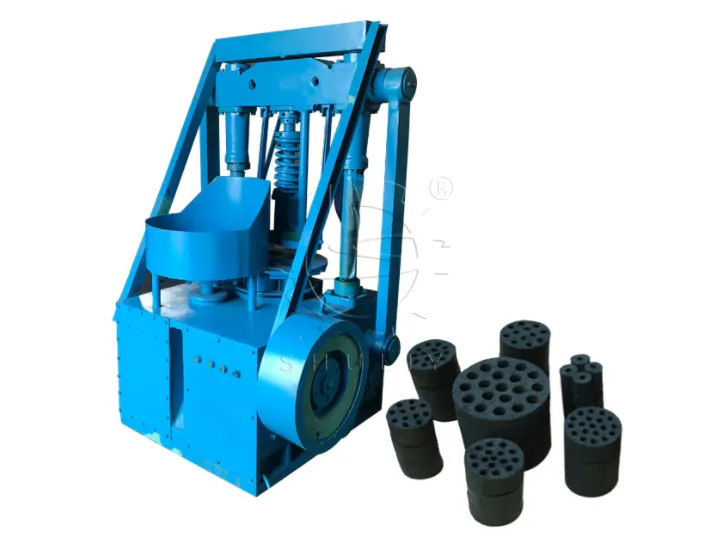
Under the strong shear and axial thrust of the alloy screw propeller, this molten lignin coats the cellulose fibers. As the extruded hollow stick emerges through the forming mold, the lignin cools and solidifies, creating a rigid, high-density briquette stick with a dark, glazed protective outer shell.
Two Golden Rules for Raw Material Preparation
Before feeding any biomass into the extruder, your raw stock must meet two non-negotiable physical standards.
1. Moisture Content: 8% to 12% (Strict Limit)
Moisture control is the single most delicate parameter in biomass extrusion:
- If moisture is > 12%: The high heat inside the forming cylinder instantly vaporizes excess water. The trapped steam expands rapidly, causing “steam explosion” (bursting), longitudinal surface cracks, low mechanical strength, or heavy white smoke blowing backward into the feed hopper.
- If moisture is < 8%: The material lacks the minimal elasticity required for smooth feeding. Friction between the screw and forming sleeve rises drastically, causing die jams, overheating, and rapid abrasive wear on the screw propeller.
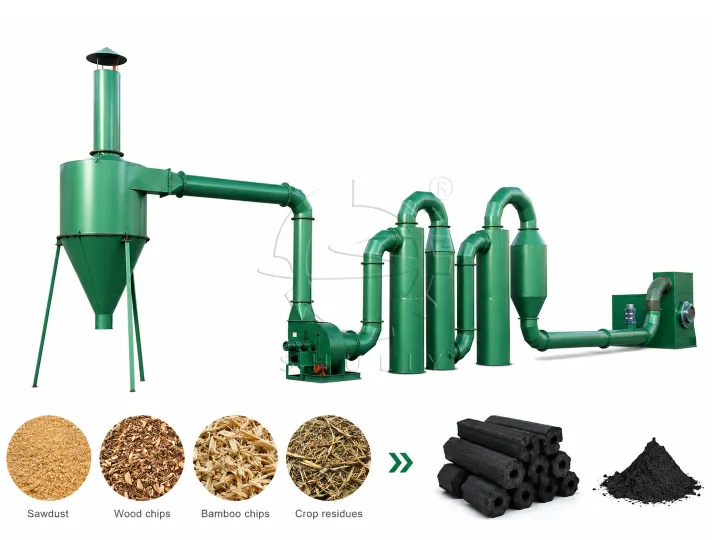
Pro Tip: If your sawdust or husks have a moisture content above 12%, an in-line Biomass Airflow Dryer or Rotary Drum Dryer must be installed before the briquetting step.
2. Particle Size: Below 6 mm (3 mm–5 mm is Optimal)
The clearance between the extruder screw propeller and the inner forming sleeve is engineered for fine granular flow:
- Biomass particles larger than 6 mm cannot receive uniform thermal conductivity, resulting in uneven lignin melting and weak internal bonding.
- Bulky chips or twigs can wedge in the feeding throat, triggering motor overload.
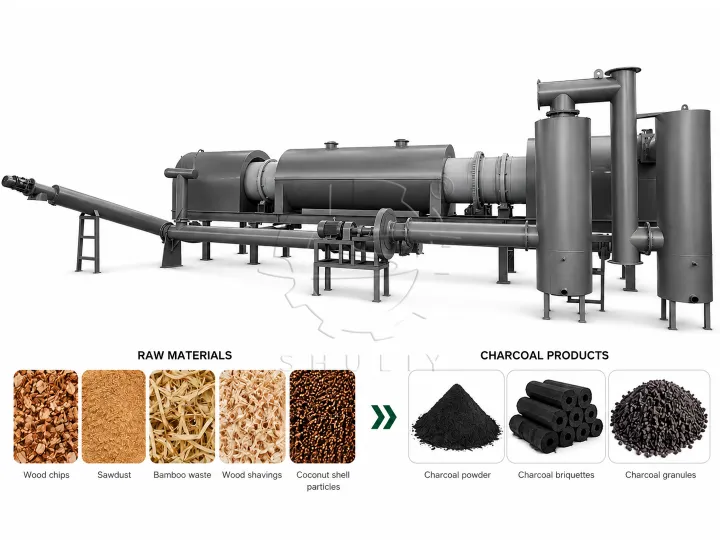
- Pre-treatment: Run coarse wood trimmings, coconut shells, or stalks through a dedicated Wood Crusher / Hammer Mill to bring them down to a uniform 3–5 mm mesh size.
Raw Material Suitability & Performance Comparison
Different biomass wastes contain varying levels of lignin, ash, and volatile matter. The table below details how common agricultural and forestry residues perform inside our extruder:
| কাঁচামাল | Lignin Content | Ash Content | Pre-treatment Needed | Briquette Quality Rating | Typical Applications |
|---|---|---|---|---|---|
| Hardwood Sawdust (Oak, Beech, Teak) | Very High (25–30%) | Low (<1%) | Screening / Drying | ★★★★★ (Superior) | Premium Export Charcoal, BBQ |
| Softwood Sawdust (Pine, Fir) | High (20–25%) | Low (<1.5%) | Screening / Drying | ★★★★☆ (Excellent) | Industrial Fuel, Heating |
| Rice Husks | Low (10–14%) | High (15–18%) | Direct use (no crushing) | ★★★☆☆ (Moderate) | Industrial Boiler Fuel, Carbonization |
| Peanut Shells | Medium (15–18%) | Moderate (3–5%) | Crushing + Drying | ★★★★☆ (Very Good) | BBQ Charcoal, Biomass Fuel |
| Sugarcane Bagasse | Medium (18–22%) | Moderate (2–4%) | Crushing + De-watering | ★★★★☆ (Good) | Boiler Fuel, Commercial Briquettes |
| Coconut Shells | Very High (>30%) | Very Low (<2%) | Crushing (Hard) | ★★★★★ (Premium) | Shisha / Hookah Charcoal, High-end BBQ |
| Coffee Husks | Medium (16–20%) | Low (3–4%) | শুকানো | ★★★★☆ (Good) | Commercial Fuel Sticks |
| Corn Cobs / Stalks | Medium (15–18%) | Moderate (4–6%) | Intensive Crushing | ★★★☆☆ (Moderate) | Household Heating, Gasifier Fuel |
Detailed Analysis of Top 5 Agro-Forestry Residues
1. Wood Sawdust & Planer Shavings (The Gold Standard)
Sawdust from sawmills, furniture plants, and plywood factories remains the most common and forgiving material for briquette production.
- Hardwoods produce dense briquettes with an extended burning time and a metallic ring after carbonization.
- Softwoods (like pine) contain natural resins that make them easy to extrude, though they burn slightly faster.
- Operational Note: If your shavings are curly, pass them through a hammer mill; curled shavings create air pockets that reduce briquette density.
2. Rice Husks (High Silicon, Abrasive Nature)
Rice husks are an abundant, low-cost byproduct in grain-growing regions. Their natural size is already under 5 mm, so no crusher is needed.
- The Challenge: Rice husks have lower natural lignin (10–14%) and high silica content (ash up to 18%). High silica accelerates screw wear.
- Best Practice: For the best results, blend rice husks with 30%–50% hardwood sawdust. This increases the total lignin content, ensures smoother extrusion, and yields stronger carbonized charcoal sticks.
3. Coconut Shells & Palm Kernel Shells (PKS)
Common throughout Southeast Asia and West Africa, coconut and palm shells yield the world’s most sought-after BBQ and shisha charcoal due to their high fixed carbon and long burn duration.
- The Challenge: Raw shells are extremely hard and irregularly shaped.
- Solution: Use a heavy-duty hammer crusher with high-manganese hammers to break shells down to ≤ 3 mm. Because of their dense structure, proper drying down to 10% moisture is critical to avoid internal stress fractures during cooling.
4. Peanut Shells & Sunflower Seed Hulls
Oil pressing factories and agricultural processing plants generate thousands of tons of clean, dry seed hulls every season.
- Peanut shells possess good natural calorific value and crush easily.
- Their low bulk density requires stable, continuous feeding into the hopper. Shuliy’s briquette machines can be fitted with an automated screw feeder to eliminate manual feed fluctuations and prevent empty barrel rotations.
5. Sugarcane Bagasse
Abundant at sugar mills, bagasse provides an excellent fibrous matrix for fuel briquettes.
- The Challenge: Fresh bagasse often carries moisture levels well above 40–50% and contains residual sugars that can caramelize and stick inside the barrel if overheated.
- Solution: Mechanically squeeze and pre-dry the bagasse, then crush it into uniform fibers before feeding. The resulting briquettes serve as an effective substitute for coal in factory boilers.
Strategic Blending: How to Process Low-Lignin Residues
If your available raw material has a low lignin profile (such as pure rice husks, straw, or grass residues), you can still produce high-grade Pini-Kay briquettes using simple blending techniques:
- The 70/30 Rule: Mix 70% low-cost agricultural waste with 30% hardwood sawdust. This supplies the necessary lignin to hold the briquette together without significantly increasing raw material acquisition costs.
- Moisture Balancing: If one material is slightly dry (e.g., 6% rice husks) and another is slightly damp (e.g., 14% fresh sawdust), pre-mixing them in a horizontal ribbon mixer allows moisture to balance out across the batch, often eliminating the need for extra drying.
How Raw Material Choice Affects Machine Wear Parts
As an equipment manufacturer, Shuliy designs every component for demanding industrial duty. However, raw material characteristics directly influence the maintenance schedule of wear parts:
- Screw Propeller Taper: Abrasive materials like unwashed sand-contaminated sawdust or high-silica rice husks wear down the leading edge of the screw faster. Shuliy provides high-chromium wear-resistant alloy welding rods and pre-balanced replacement heads with every machine, allowing your maintenance team to re-surface worn screw heads on-site.
- Forming Sleeve & Mold: Clean hardwood sawdust typically allows a forming mold to run for 80–120 tons of production before maintenance. Highly abrasive materials may reduce this interval to 40–60 tons, underscoring the importance of sourcing clean, soil-free feedstock.
Not Sure If Your Material Is Suitable? Test It With Shuliy
Every biomass residue behaves differently under high heat and pressure. Guessing your material’s behavior can lead to costly downtime or misconfigured production lines.
At Shuliy Machinery, we operate a dedicated biomass testing lab:
- Send Us Your Raw Material Samples (5–10 kg): Our engineers will test your material for natural moisture, ash content, and density limits.
- Live Trial Extrusion Video: We will run your material through our SL-140 or SL-180 briquette machine in our workshop, record the extrusion process, and evaluate the final briquette stick.
- Custom Production Line Blueprint: Based on your material’s initial condition, we will configure the exact combination of wood crushers, dryers, screw extruders, and carbonization furnaces to match your target output.
Contact our engineering team today to evaluate your raw materials and turn agricultural or forestry waste into profitable biomass fuel.
WhatsApp / Direct Call: +86 17303831295
Official Email: info@shuliyrecycle.com
Address: Nautical Road East, Zhengzhou Economic Development Zone, Henan, China