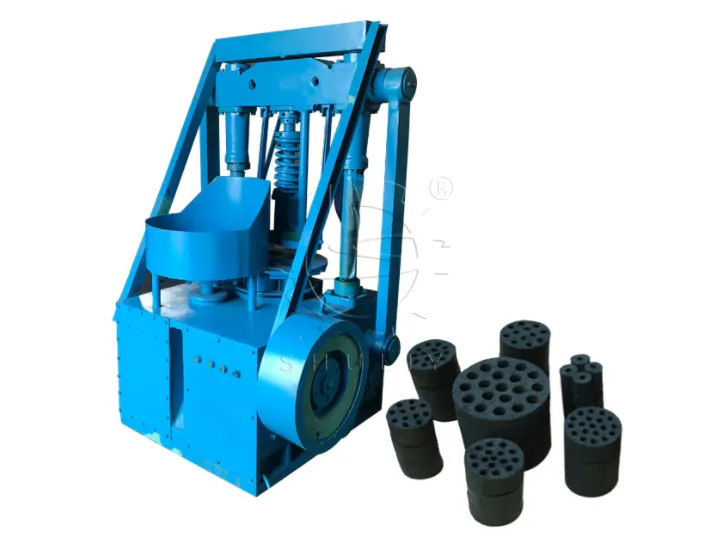
Every pile of sawdust, rice husk, and farm residue is potential fuel — but loose biomass is dusty, bulky, and hard to sell. A biomass briquette press solves this in one step: it compresses fine, dry biomass into dense, hollow briquette sticks that burn long and clean, feed directly into a carbonization furnace, and sell at a far better price than raw waste.
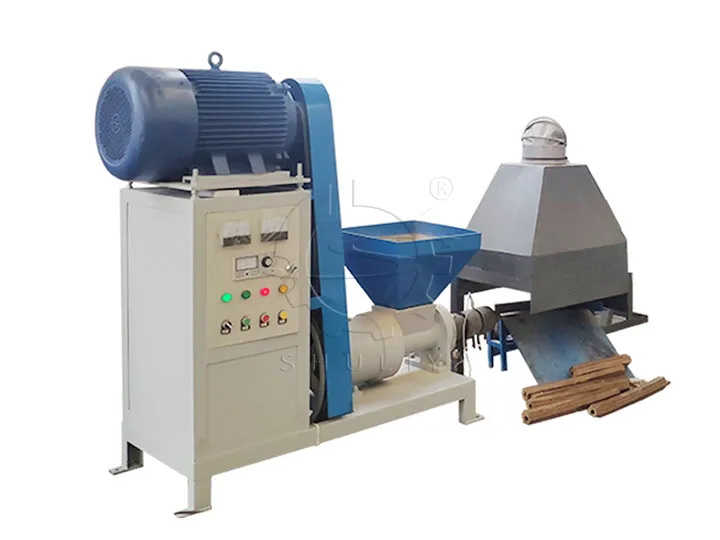
Shuliy’s biomass briquette press — also known as a sawdust briquette machine — works by screw extrusion at 260–380°C. Under heat and pressure, the natural lignin inside the biomass softens and binds the particles together — so no chemical binder is needed at any stage. One machine feeds continuously, runs all day, and turns what used to be a disposal problem into your main product.
What Can a Biomass Briquette Press Process?
Any lignin-containing biomass with the right preparation works as briquette feedstock:
- Wood-based: sawdust, wood shavings, planer dust, bamboo powder, furniture sanding waste
- Farm residues: rice husk, peanut shell, corn cob, sugarcane bagasse, coffee husk
Two numbers decide whether your material will form well:
| Requirement | Standard |
| Moisture content | 8–12% (wet basis) |
| Particle size | ≤ 6 mm |
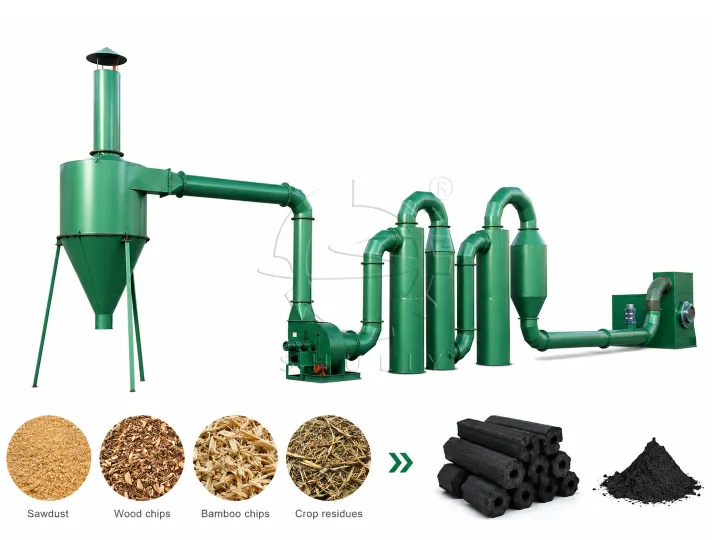
Material that is too wet cracks as it leaves the mold; too dry, it bonds poorly. Oversized particles jam the screw. That’s why a working line pairs this machine with a rotary dryer and a hammer mill upstream — the biomass briquette press itself is only as good as the material you feed it.
How Does the Biomass Briquette Press Work?
Making sawdust briquettes takes four continuous steps:
- Feeding. Prepared material is loaded into the hopper and conveyed into the extrusion chamber. Keep the hopper supplied — a continuous, even feed is what keeps briquette density stable.
- Heating & compression. As the screw propeller rotates, it pushes the material forward while the heating ring raises the chamber to the set temperature (typically 260–380°C, adjustable by material — rice husk runs cooler, hardwood sawdust hotter).
- Lignin binding. At working temperature, the lignin plasticizes and glues the fine fibers together under high pressure — nature doing the work of a chemical binder.
- Forming & cutting. The material is extruded through the mold into a hollow, hexagonal stick (the center hole helps combustion and later carbonization) and cut to your required length by the breaking frame.
Why Screw Type — Not a Hydraulic Sawdust Briquette Press?
Buyers comparing options often ask about the hydraulic sawdust briquette press. The difference matters for your output:
- Continuous vs. cyclic. A hydraulic press works stroke by stroke; a screw-type biomass briquette press extrudes nonstop, so hourly output is several times higher for the same motor power.
- No binder, lower cost. Screw forming relies on lignin and heat; many hydraulic processes need starch binders and a mixing step.
- Denser stick, better charcoal. Screw-extruded rods reach 900–1300 kg/m³ — the density that later becomes hard, long-burning, machine-made charcoal.
Hydraulic presses have their place for powder-type materials; for wood and farm residues, screw extrusion is what every professional sawdust briquette making machine uses — and it is the only way to run binder-free.
Inside the Machine: Structure That Decides Quality
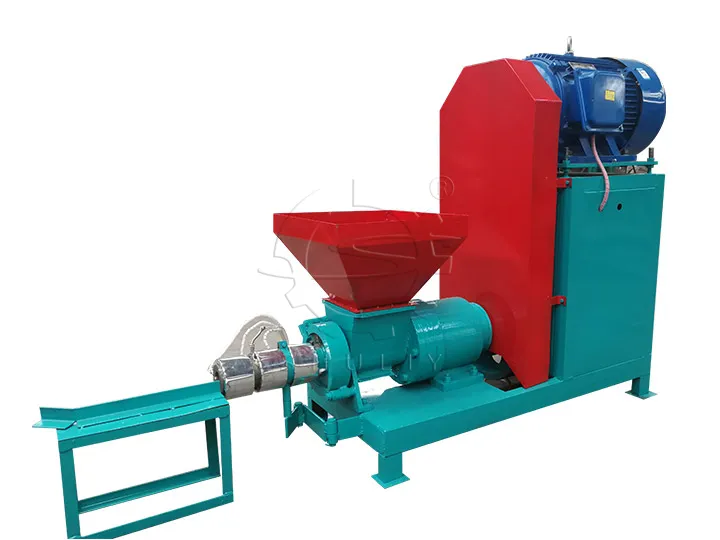
- Screw propeller: the heart of the biomass briquette press. Its wear-resistant welded tip is the part that actually compresses the material; it is repairable by re-welding, which keeps long-term running costs low.
- Heating ring & temperature controller: maintains the set forming temperature automatically, so quality doesn’t depend on the operator’s feel.
- Forming mold (tube): shapes the 46–50 mm hollow stick; replaceable molds change diameter and hole size.
- Reversing motor control: clears jammed material in seconds instead of manual dismantling.
- Heavy steel frame: 630–780 kg of machine weight for stable, vibration-free continuous running.
Technical Parameters
| Modell | Kraft | Heating Power | Veselheid | Briquette Diameter |
| SL-140 | 11 kW | 3 kW | 200–250 kg/h | 50 mm |
| SL-180 | 22 kW | 5.5 kW | 350–450 kg/h | 50 mm |
- Hollow hole diameter: 10–20 mm; rod length adjustable at the cutting frame.
- We assemble and factory-test every biomass briquette making machine before delivery. Voltage and specifications can be customized to your local power supply — tell us your material and target output, and we will match the model.
What Are the Briquettes Used For?
This is where the business case gets clear. The sticks coming out of your biomass briquette press have two profitable destinations:
- Direct biomass fuel. Easy to ignite, high calorific value, low ash — sold to households, restaurants, and boilers as a clean alternative to firewood and coal.
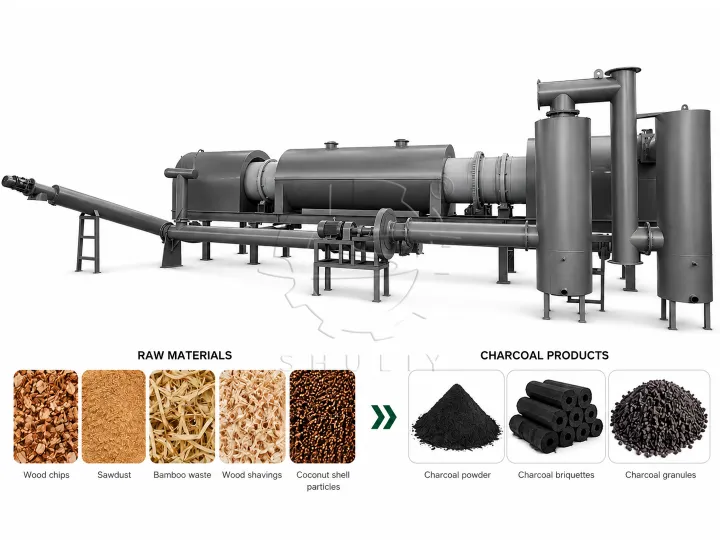
- Raw material for machine-made charcoal. Carbonize the sticks in a carbonization furnace, and you upgrade the same product into charcoal worth significantly more per ton — fixed carbon 80–85%, burning time 3–4 hours, ready for BBQ and industrial markets.
One machine, two products, and the second one sells for more. That’s why a biomass briquette press is the core of every sawdust briquette maker’s business plan.
From a Single Machine to a Complete Biomass Briquetting Plant
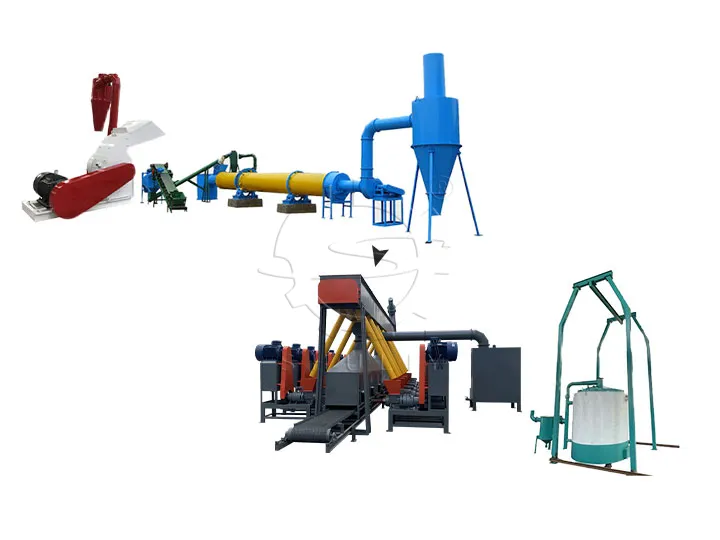
One biomass briquette press works for trials and small workshops. For stable commercial output, the standard configuration is:
Drum wood chipper → hammer mill → rotary dryer → biomass briquette press → carbonization furnace
Each upstream machine protects the one after it: the chipper and hammer mill secure the ≤6 mm particle size, the dryer secures the 8–12% moisture, and the press then produces uniformly dense rods — batch after batch, without cracking. For clients planning a full biomass briquetting plant, we design the layout around your material and space, with capacities from 500 kg/h to several tons per day.
FAQ
1. Do I need to add any binder?
No. The lignin naturally present in biomass does the binding at 260–380°C. This keeps your formula clean and your cost down — a key advantage over binder-based briquetting.
2. What happens if my material is wetter than 12%?
Briquettes crack and break apart. Run the material through a rotary dryer first; most clients pair the two machines from day one.
3. How often do wear parts need attention?
The screw propeller tip and forming tube are the main wear parts. The propeller is re-weldable — with normal use it is rebuilt rather than replaced, keeping spare-part costs among the lowest of any biomass briquettes manufacturing machine.
4. Can one machine support a commercial plant?
For small and mid-scale production, yes. Above ~400 kg/h, most clients run two or more presses in parallel fed by one dryer — a standard layout we can design for you.
5. What is the sawdust briquette machine price?
Whether buyers compare it as a sawdust briquette machine price or a biomass briquettes machine price, the rule is the same: buy from the manufacturer, not the dealer. Price depends on model, heating configuration, and shipping terms — send your raw material and capacity target, and you will have a model recommendation and factory-direct quotation within 24 hours.
Get Your Biomass Briquette Press Quote
Looking for a sawdust briquette machine for sale at factory-direct pricing? Tell us what material you have na how many kilograms per hour you need. Our engineers will recommend the right model, confirm whether your raw material needs a dryer upgrade, and send a complete quotation — machine only, or a full biomass briquetting plant layout. Factory-direct, tested before delivery, with installation guidance worldwide.