Tanzania’s poultry sector is expanding faster than almost any other segment of its agricultural economy. Between 2019 and 2025, the national poultry population grew from 79.1 million to over 113 million birds, and the government’s 10-year poultry strategy targets an increase in annual egg output from 7.1 billion to more than 17 billion eggs. For layer farmers in Dar es Salaam, Arusha, Mwanza, and emerging production zones, this growth brings a familiar bottleneck: not enough egg trays.
Most small and medium farms in Tanzania still buy molded pulp egg trays from a handful of local suppliers or import them from overseas. Lead times are long, prices fluctuate, and during peak production seasons the trays simply run out. A farmer who cannot package eggs cannot sell them — at least not without breakage rates that erase the profit margin.
This case study explains how one Tanzanian poultry farm owner eliminated that bottleneck by installing his own egg tray production machine on site. It covers the raw material question (can river water be used for pulp?), the machine selection, the drying challenge in a humid tropical climate, and the final layout that fit his available land.
The Client: A Layer Farm Owner with a Packaging Gap
The client operates a commercial layer farm in Tanzania. As his flock expanded, he found himself in a situation that many African poultry producers recognize: his daily egg collection outpaced his ability to source clean, sturdy egg trays. He was buying trays from third-party suppliers, but supply was unreliable and the quality inconsistent — some trays were too soft to protect eggs during transport to local markets.
He decided that producing egg trays in-house was the most reliable long-term solution. His goals were straightforward:
- Produce enough egg trays to cover his own farm’s daily needs
- Use low-cost, locally available raw materials
- Keep the investment and footprint manageable for a first-time operator
- Eventually sell surplus trays to neighboring farms
His factory site had one notable feature: a river ran alongside the property. His first question to us was whether river water could be used in the pulping process of an egg tray production machine.
Challenge 1: Can River Water Be Used for an Egg Tray Production Machine?
Water quality is a common concern for buyers setting up a new egg tray production machine, especially in regions where municipal water is expensive or unavailable. The pulping process mixes waste paper with water to create a uniform fiber slurry, and the water does not need to be drinking-quality — but it does need to be relatively clear and free of excessive sediment, oil, or strong contaminants.
We advised the client that river water can absolutely be used, provided it passes through a simple settling tank and filtration step before entering the pulper. A settling basin allows sand and silt to drop out, and a basic mesh filter catches remaining debris. This is a low-cost modification that many African customers already implement on their farms.
We also confirmed that the water used in an egg tray machine is largely recyclable. The closed-loop system recirculates most of the process water, so only a small top-up is needed to compensate for evaporation and the moisture retained in the wet trays. For a farm with river access, this makes the operating cost of water essentially negligible.
Challenge 2: Selecting the Right Machine Capacity
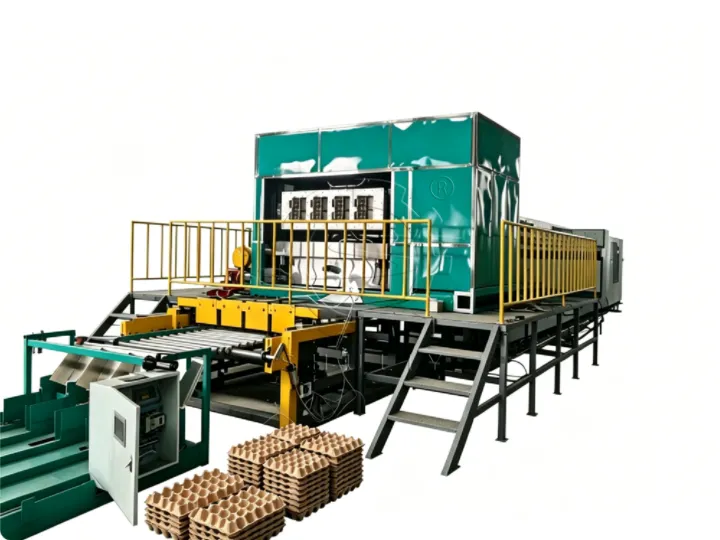
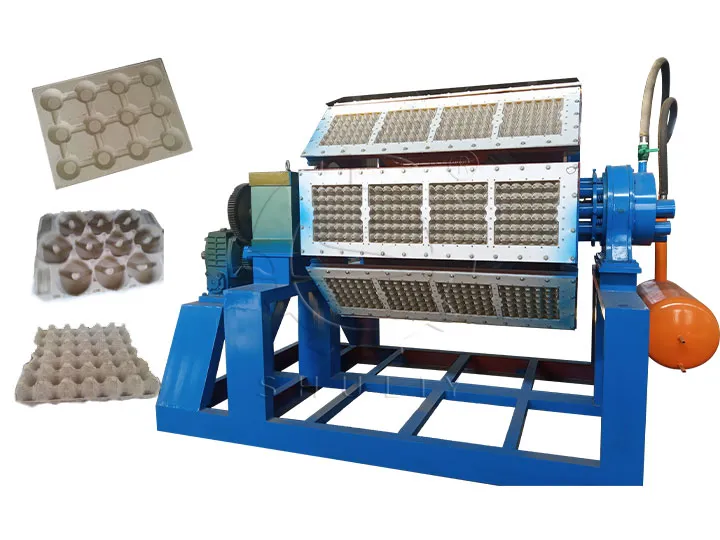
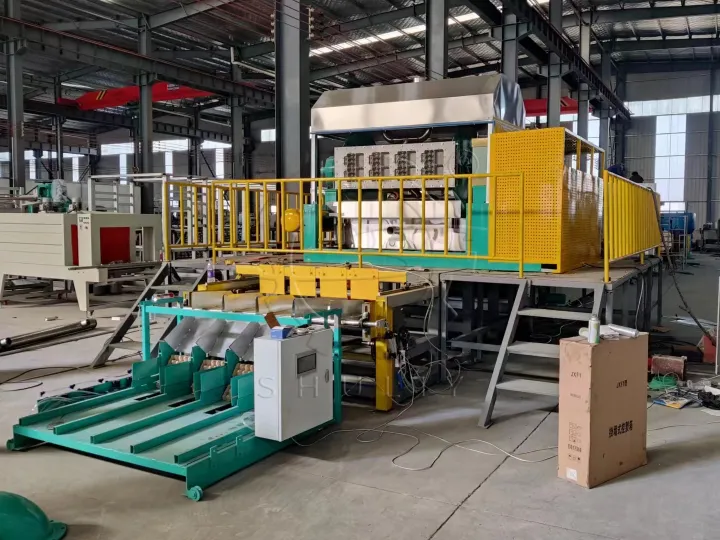
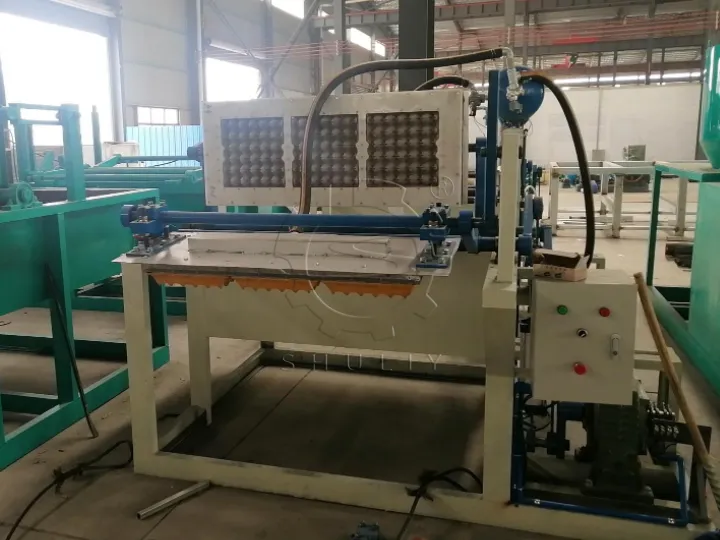
After reviewing the client’s flock size and daily egg output, we recommended the 3×1 egg tray production machine configuration. The “3×1” refers to a forming machine with three molds on one side, which is a compact, entry-level setup ideal for small and medium producers.
Key specifications of the recommended 3×1 configuration:
| Parameter | Detail |
|---|---|
| Molds per cycle | 3 egg trays |
| Cycle time | Approximately 40–50 seconds |
| Hourly output | Roughly 200–250 trays/hour |
| Raw material | Waste paper, old newspapers, cardboard |
| Power requirement | 3-phase electricity |
| Footprint (forming + pulping) | ~60–80 m² |
| Drying area (natural sun drying) | ~500 m² |
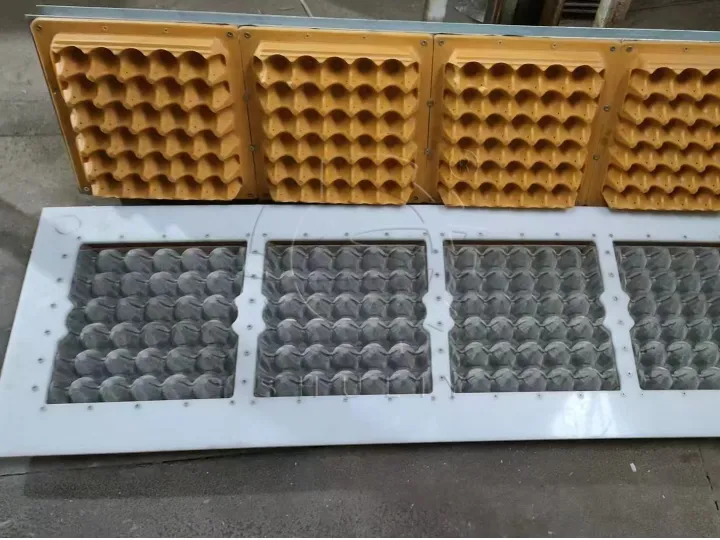
This capacity was well matched to the client’s own farm consumption and left room to produce surplus trays for local sale. We also sent him a full set of mold drawings so he could see exactly how different tray designs — standard 30-cell egg trays, egg cartons, and even fruit trays — could be produced on the same pulp molding machine by swapping molds.
Challenge 3: The Drying Problem in a Humid Climate
One of the most critical decisions in any egg tray production line project is how to dry the wet trays after they come off the forming machine. In a dry climate, natural sun drying on wire racks can work well. In Tanzania’s tropical humidity, however, relying solely on sun drying is risky — trays take longer to dry, and during the rainy season they may not dry at all, leading to mold, weak trays, and production stoppages.
The client initially asked about coal as a fuel source for a dryer, wanting to understand the cost. We analyzed his local climate and production plan and recommended a drying chamber (drying oven) instead of depending on natural drying alone. A drying chamber uses heated air circulated through a rack system, removing moisture consistently regardless of weather.
For a 3×1 egg tray production machine, a moderate-sized drying chamber is sufficient. The wet trays are placed on drying carts (the client purchased a small transfer cart and 30 drying mesh racks) and rolled into the chamber. This setup:
- Cuts drying time from days (sun drying) to hours
- Produces uniformly strong, rigid egg trays
- Eliminates rain-related production downtime
- Uses a fraction of the land area required for sun drying (500 m² reduced to a compact enclosed space)
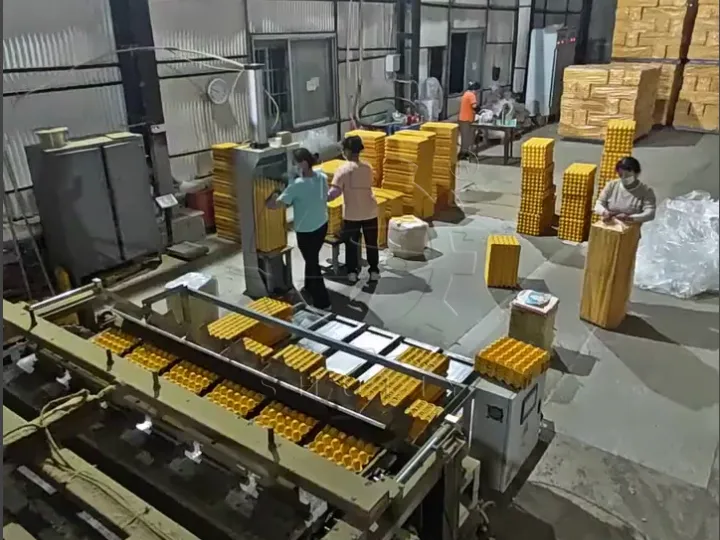
We also tested sample egg trays produced on our machines to demonstrate the difference in stiffness and thickness compared with the soft, low-quality trays he had been buying. The comparison was convincing: properly dried molded pulp trays are rigid enough to stack multiple layers without cracking, which directly reduces egg breakage during transport.
Site Preparation and Layout
Before shipping, we worked with the client on site planning. For the forming and pulping area, we recommended a covered space of 60–80 square meters. This houses the pulper, the forming machine, the vacuum pump, and the wet tray transfer area. If he had chosen natural sun drying, an additional 500 m² of open, flat, well-drained ground would have been needed for the drying racks. With the drying chamber, that outdoor requirement disappears.
We also confirmed his three-phase electricity supply, since the vacuum pump and main drive motor of the egg tray manufacturing machine require 3-phase power. He sent us photos and videos of his factory site so our engineers could verify the layout, cable routing, and water inlet position before finalizing the equipment list.
What the Client Purchased
The final package for this Tanzanian egg tray production machine project included:
- 3×1 egg tray forming machine — the core molding unit
- Pulping system — hydrapulper for converting waste paper into fiber slurry
- Vacuum pump — for consistent mold filling and dewatering
- Drying chamber — heated-air drying for year-round production
- Drying carts and 30 mesh drying racks — for loading wet trays into the dryer
- Spare molds and mold drawings — for 30-cell standard egg trays, with options for other tray types
- Installation guidance and operator training — remote support plus documentation
We also assisted with sea freight quotations to Dar es Salaam, helping the client understand total landed cost rather than just the machine price.
Why This Configuration Works for African Poultry Farms
This project is representative of a growing trend across sub-Saharan Africa. Poultry farmers who once saw egg trays as a minor consumable are now treating in-house egg tray manufacturing as a strategic investment. The reasons are consistent across markets:
- Raw materials are local and cheap. Waste newspapers, old cartons, and office paper are available in every town at very low cost. One ton of waste paper yields roughly 14,000–16,000 egg trays.
- Labor is simple to train. A 3×1 waste paper egg tray machine can be operated by 2–3 workers after a short training period.
- The product sells itself. Every poultry farm within trucking distance is a potential customer for surplus trays.
- Water and energy costs are controllable. Recycled process water and a modest drying chamber keep operating expenses predictable.
For farmers in Tanzania, Kenya, Uganda, Zambia, Nigeria, and similar markets, a small automatic egg tray machine is not just a packaging solution — it is a second revenue stream and a hedge against supply chain disruption.
Results and Next Steps
At the time of writing, the client’s equipment has been shipped and he is preparing his site for installation. Based on comparable 3×1 egg tray production machine installations we have delivered across Africa, he can expect:
- Steady production of 1,500–2,000+ egg trays per 8-hour shift
- Full coverage of his own farm’s packaging needs within the first month
- The ability to sell surplus trays to neighboring farms and local egg distributors
- A payback period that is typically measured in months, not years, when tray replacement costs are factored in
He has already expressed interest in adding additional molds for fruit trays and bottle carriers as his confidence in the process grows — a common progression for customers who start with a single paper pulp egg tray machine.
Thinking About Your Own Egg Tray Production Machine?
If you are a poultry farmer, packaging distributor, or entrepreneur in Africa or elsewhere considering an egg tray production machine, the first step is a simple conversation about your raw materials, available space, power supply, and target output. Every farm is different — a site with river access, a 3-phase power connection, and 80 m² of covered space may be ready for a 3×1 line tomorrow, while another site may need a different capacity or drying approach.
Shuliy has supplied egg tray production machines and complete pulp molding lines to customers in over 50 countries, including multiple installations in Tanzania and across East Africa. We provide factory testing before shipment, installation guidance, operator training, and after-sales support. Tell us about your farm or project, and we will recommend a configuration that fits your budget and your production goals.