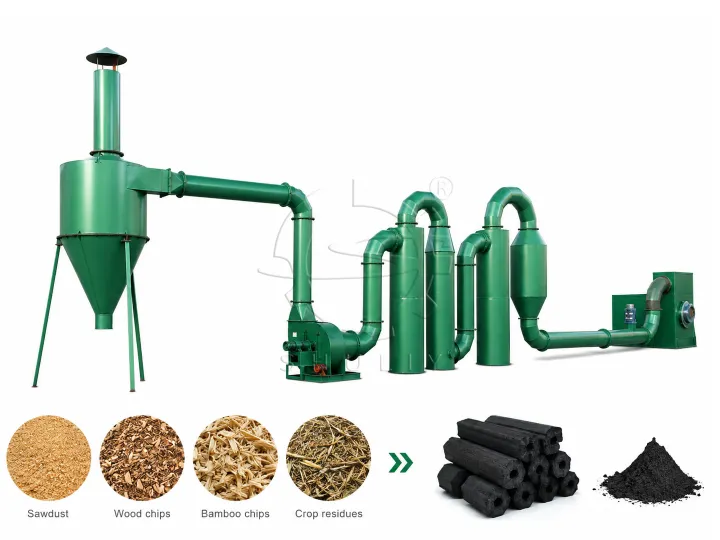
The biomass airflow dryer rapidly reduces moisture in sawdust and crushed biomass before briquetting and carbonization. It provides continuous, efficient drying for biomass fuel and charcoal production.
Biomass Airflow Dryer in a Charcoal Production Line
A complete biomass charcoal production line typically follows:
Drum Wood Chipper → Hammer Mill → Biomass Airflow Dryer → Sawdust Briquette Machine → Carbonization Furnace
The biomass airflow dryer is installed after fine crushing and before briquetting, preparing the material for stable downstream processing.
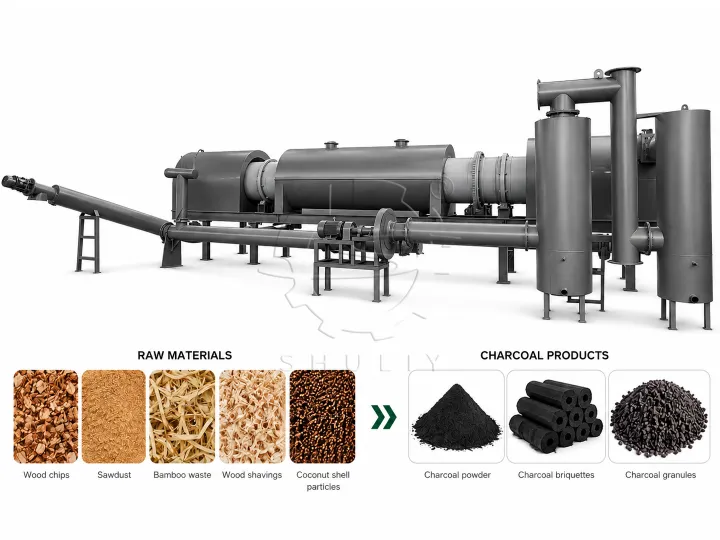
Raw Materials → Dried Biomass → Final Products
| Rohstoffe | After Drying | Final Applications |
|---|---|---|
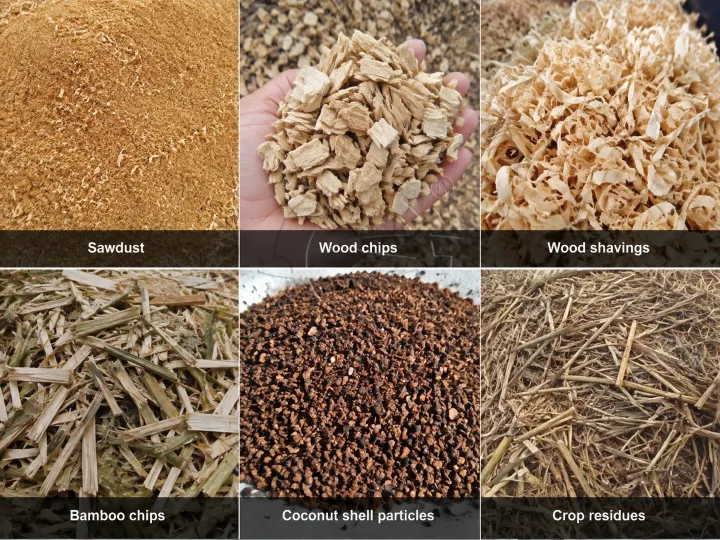
| Sawdust | Dried sawdust | Charcoal briquettes |
| Wood chips & shavings | Dried wood particles | Biomass fuel |
| Bamboo waste | Dried biomass | Biomass charcoal |
| Coconut shell particles | Dried particles | Charcoal products |
| Other crushed biomass | Dried biomass | Briquetting & carbonization |
This makes the biomass airflow dryer suitable for sawdust briquette production, biomass fuel production, and biomass charcoal production.
Working Principle & Main Structure
The biomass airflow dryer combines material conveying, hot-air drying, and dust separation in one continuous process.
① Controlled Feeding
Wet sawdust enters the dryer through a screw feeder. Variable-frequency speed control allows the feeding rate to be adjusted according to the production requirement.
② High-Speed Hot-Air Drying
A biomass hot air furnace supplies heated air. The wet particles are dispersed into the high-speed airflow and transported through the drying pipe. Heat and mass transfer occur rapidly as moisture evaporates.
③ Cyclone Separation
After drying, the material enters a cyclone separator, where most of the dried biomass is separated from the airflow.
④ Dust Collection & Discharge
Fine particles are captured by the pulse bag dust collector, while the dried biomass is continuously discharged for the next briquetting process.
Main components:
Biomass Hot Air Furnace + Blower + Screw Feeder + Drying Pipe + Cyclone Separator + Pulse Bag Dust Collector + Induced Draft Fan + Control System
The reference airflow drying system uses a screw feeder, drying pipe, cyclone separator, and pulse bag dust collector as its main process sections.
Advantages of the Biomass Airflow Dryer
Fast Drying
Small biomass particles are highly dispersed in the hot airflow, providing a large effective heat-transfer area. The reference system indicates a gas-solid contact drying time of about 1.5–2 seconds.
Continuous Operation
Material feeding, drying, separation, and discharge can operate continuously, making the machine suitable for commercial biomass processing lines.
Adjustable Feeding
The screw feeder can be equipped with variable-frequency speed control to match different material feeding requirements.
Integrated Dust Collection
The cyclone separator recovers dried material, while the pulse bag filter captures fine dust from the exhaust airflow, improving material recovery and operating conditions.
Easy Production-Line Integration
The dryer can be directly connected with a hammer mill, sawdust briquette machine, and carbonization furnace to form a continuous biomass charcoal production process.
Biomass Airflow Dryer Specifications
We offer different biomass drying machine models according to production requirements:
| Modell | Kapazität | Leistung |
|---|---|---|
| SL-219 | 300–400 kg/h | 5,5 kW |
| SL-320 | 500–600 kg/h | 7,5 kW |
The listed capacities are based on the supplied machine information. Actual drying performance depends on the biomass type, initial moisture, required final moisture, particle size, and heat source.
How to Choose the Right Biomass Airflow Dryer?
Choosing a biomass airflow dryer should be based on the complete drying requirement rather than capacity alone.
1. Raw Material
Different materials have different particle sizes, densities, and moisture characteristics. Tell us whether you are drying sawdust, wood chips, bamboo waste, coconut shell particles, or another biomass.
2. Initial & Final Moisture
The amount of water that needs to be removed directly affects the required drying capacity and heat demand. Provide both the initial moisture content and target final moisture content whenever possible.
3. Required Capacity
Capacity should match the production rate of your briquette machine and carbonization furnace. A dryer that is too small may become a bottleneck in the production line.
4. Available Heat Source
Tell us whether you plan to use biomass, wood, gas, diesel, steam, or another heat source. We can recommend a suitable heating configuration according to the project.
5. Complete Line or Individual Machine
If you already have crushing or briquetting equipment, the dryer can be selected to match your existing system. If you are starting a new charcoal project, we can design the complete biomass charcoal production line around your required output.
Send us your raw material, moisture content, required capacity, and heat source. We can recommend the suitable biomass airflow dryer and configuration for your project.
Biomass Airflow Dryer FAQ
Can this dryer dry sawdust?
Yes. The biomass airflow dryer is suitable for sawdust and other small, loose biomass particles.
Is it suitable for charcoal production?
Yes. It is normally installed before the sawdust briquette machine to reduce excess moisture before briquetting and carbonization.
Can I buy only the biomass dryer?
Yes. You can purchase an individual biomass drying machine for an existing production line or combine it with our crushing, briquetting, and carbonization equipment.
What is the dryer capacity?
The available models cover approximately 300–400 kg/h and 500–600 kg/h. Larger systems can be selected according to the required production capacity and material conditions.
Get a Suitable Biomass Drying Solution
Looking for a biomass airflow dryer, sawdust dryer, or complete charcoal production line?
Send us your raw material, moisture content, and required capacity. Shuliy will recommend a suitable drying solution and help integrate it with your existing or new biomass processing equipment.