Every year, rice mills across Southeast Asia, South Asia, and West Africa generate tens of millions of tons of raw paddy husks. Often treated as a cumbersome disposal problem, this agricultural residue holds immense commercial potential. Understanding how to make charcoal from rice husk has become one of the most profitable inquiries for biomass recyclers and energy entrepreneurs today.
However, many investors who explore how to make charcoal from rice husk mistakenly assume that processing husks is identical to processing ordinary wood sawdust. When feeding raw husks into standard extruders, they frequently encounter severe screw wear, cracked briquette sticks, or low machine yield.
In this technical guide, Shuliy Machinery breaks down the complete industrial method of how to make charcoal from rice husk, contrasts it with traditional wood sawdust processing, and reveals how to configure the right equipment for maximum profitability.
Rice Husk vs. Wood Sawdust: Chemical & Physical Comparison
To master how to make charcoal from rice husk, you must first understand the fundamental structural differences between grain residues and forestry timber.
| Parâmetro | Raw Rice Husks (Paddy Chaff) | Hardwood Sawdust | Operational Impact |
|---|---|---|---|
| Natural Lignin Content | 10% – 14% | 25% – 30% | Low lignin in rice husk requires higher molding heat. |
| Silica / Ash Content | 15% – 18% | < 1.0% | High silica in rice husks causes rapid abrasive wear. |
| Initial Particle Size | 2 mm – 5 mm (Uniform) | 1 mm – 15 mm (Irregular) | Rice husks require no crusher; sawdust often does. |
| Bulk Density | 100 – 120 kg/m³ | 180 – 250 kg/m³ | Rice husks need forced screw feeding into the extruder. |
| Initial Moisture | 10% – 14% (Relatively dry) | 20% – 50% (Green wood) | Sawdust requires heavier pre-drying before extrusion. |
Unlike wood sawdust, which is packed with natural lignin, rice husks are enclosed in an abrasive silica sheath. This single characteristic explains why learning how to make charcoal from rice husk requires specialized machine engineering.
Step-by-Step: How to Make Charcoal from Rice Husk Industrially
Processing loose husks into dense, carbonized briquette sticks involves five coordinated manufacturing steps.
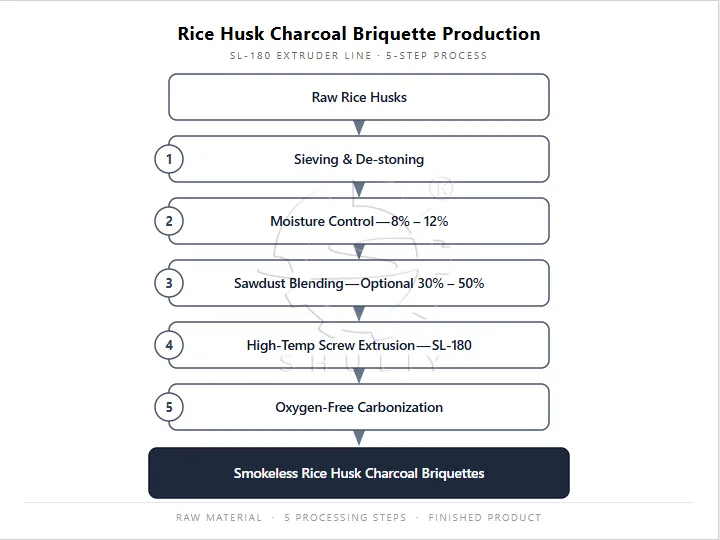
Step 1: Pre-Cleaning and Sieving
When analyzing how to make charcoal from rice husk, never skip pre-cleaning. Raw paddy husks from grain mills often contain tramp iron, sand, and pebbles. Passing husks through a vibrating rotary screen and magnetic separator protects your extruder’s screw propeller from premature mechanical failure.
Step 2: Moisture Regulation (8% to 12%)
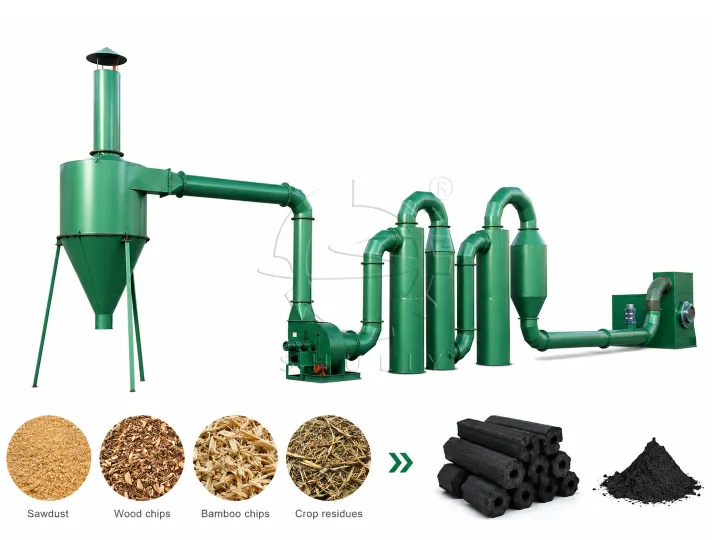
Moisture regulation is your next critical hurdle in how to make charcoal from rice husk. While fresh rice husks typically enter storage at 11% to 14% moisture, briquetting requires a precise window of 8% to 12% (as outlined in our briquette raw material moisture guide). If your husks have absorbed ambient humidity, a fast-pass Biomass Airflow Dryer is necessary to strip surface dampness without over-drying the fiber.
Step 3: Material Blending (The Commercial Secret)
A proven industry practice for anyone researching how to make charcoal from rice husk is blending. While pure 100% rice husk can be extruded, blending 60% rice husks with 40% hardwood sawdust produces superior results:
- It increases the overall lignin ratio, producing a mirror-smooth outer shell.
- It reduces total ash content in the final BBQ charcoal.
- It extends the service life of the machine’s internal wear parts by up to 50%.
Step 4: High-Pressure Extrusion
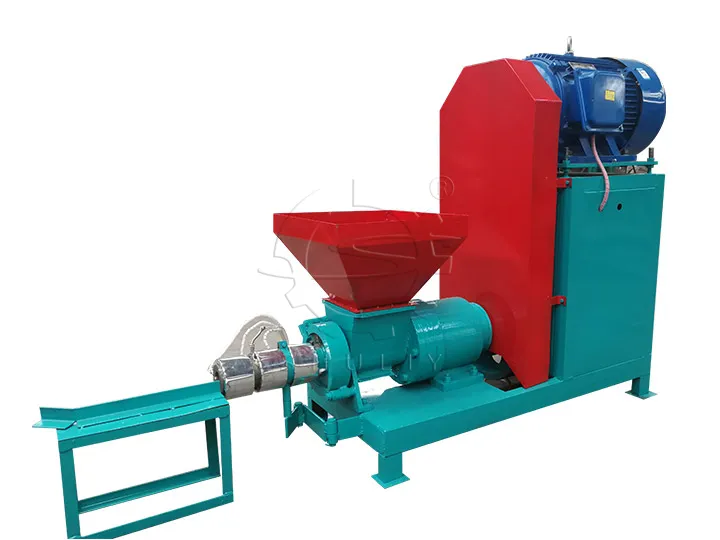
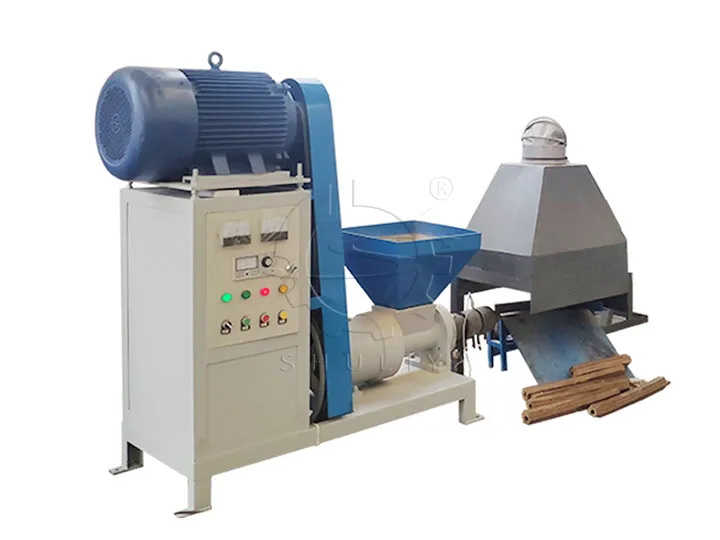
This stage represents the physical core of how to make charcoal from rice husk. The conditioned husks enter the feed hopper of our industrial screw-type charcoal briquette machine.
- The internal heating elements maintain an elevated cylinder temperature of 320°C to 350°C (roughly 30°C higher than pure wood sawdust) to soften the husk’s limited lignin.
- The specialized alloy screw compresses the material into a continuous 50 mm hollow hexagonal stick (Pini-Kay style).
Step 5: High-Temperature Carbonization
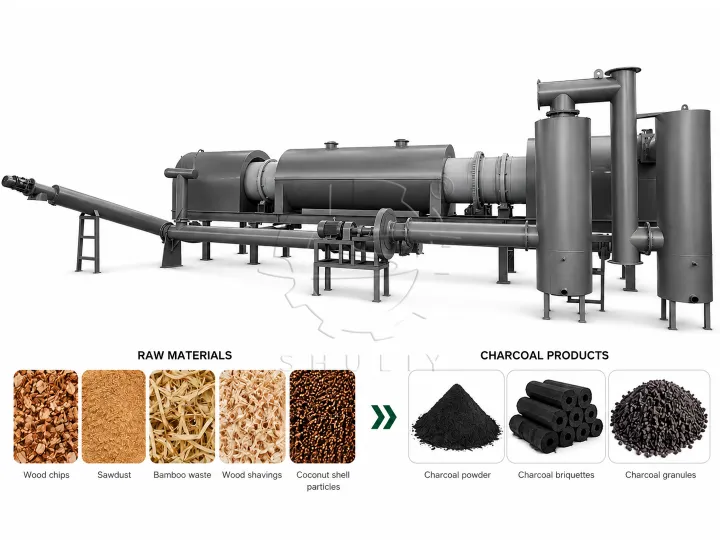
The final carbonization stage completes the cycle of how to make charcoal from rice husk. The extruded biomass sticks are stacked inside a hoisting or continuous carbonization furnace. Over a 6-to-8-hour thermal cycle at 450°C–550°C under anoxic (oxygen-deprived) conditions, volatile matter and moisture are expelled, leaving behind solid, smokeless, high-carbon fuel sticks.
Critical Machine Adjustments: How to Make Charcoal from Rice Husk Without Clogging
If you want to master how to make charcoal from rice husk at an industrial scale, standard wood extruders will fail prematurely without two critical design adaptations:
1. High-Chromium Hardfacing on Screw Propellers
Because rice husks carry 15% to 18% silica (essentially natural glass micro-particles), screw propeller wear is three times faster than with wood sawdust. Shuliy’s SL-140 and SL-180 extruders utilize proprietary high-chromium alloy welding layers on the screw flutes. This hardfacing resists abrasive gouging and ensures thousands of hours of stable compression.
2. Forced Feeder to Prevent Hopper Bridging
Rice husks are lightweight and prone to bridging over the feed port, causing the screw to run dry. Our specialized briquetting machine can be retrofitted with an automatic dual-axis overhead feeding screw to force the bulky chaff evenly into the forming barrel.
Performance Comparison: Rice Husk Charcoal vs. Sawdust Charcoal
Before investing in equipment for how to make charcoal from rice husk, commercial producers should compare the practical market performance of the two finished fuels:
| Metric | 100% Rice Husk Charcoal | 100% Hardwood Sawdust Charcoal | 60/40 Blended Charcoal |
|---|---|---|---|
| Calorific Value | 4,200 – 4,800 kcal/kg | 6,500 – 7,200 kcal/kg | 5,600 – 6,200 kcal/kg |
| Ash Content | 18% – 22% (White-grey) | 1.5% – 3.0% (Light grey) | 7% – 9% (Acceptable) |
| Burn Duration | 2.5 – 3.5 Hours | 4.5 – 6.0 Hours | 3.5 – 4.5 Hours |
| Market Positioning | Boiler fuel, soil biochar | Premium BBQ, shisha charcoal | Commercial BBQ, poultry heating |
| Raw Material Cost | Near zero / Very low | Moderate | Low |
Equipment Checklist: How to Make Charcoal from Rice Husk at Scale
Setting up a commercial plant requires a balanced line. When planning how to make charcoal from rice husk, your core machinery layout includes:
- Airflow Sawdust/Husk Dryer: Removes excess moisture continuously using minimal electrical power.
- Horizontal Ribbon Blender: Mixes rice husks with sawdust or other biomass residues uniformly.
- Shuliy Screw Briquette Machine (SL-180): Features wear-resistant alloy screws and digital PID temperature controllers.
- Hoist Carbonization Furnace: Converts extruded fuel logs into finished high-carbon fuel sticks with zero toxic smoke emissions.
Start Your Rice Husk Briquetting Business with Shuliy
Mastering how to make charcoal from rice husk requires proven machinery and experienced engineering support.
Whether you are evaluating how to make charcoal from rice husk, bagasse, or forestry sawdust, Shuliy Machinery designs and manufactures heavy-duty processing systems tailored to your local material characteristics:
- Raw Material Lab Testing: Ship your rice husks to our Zhengzhou factory; our engineering team will test their compaction threshold and shoot live extrusion trial videos.
- Custom Plant Sizing: We supply scalable production lines from 250 kg/h to 5 tons per hour.
Contact Shuliy Machinery today for equipment specifications, custom layout drawings, and factory-direct quotations.